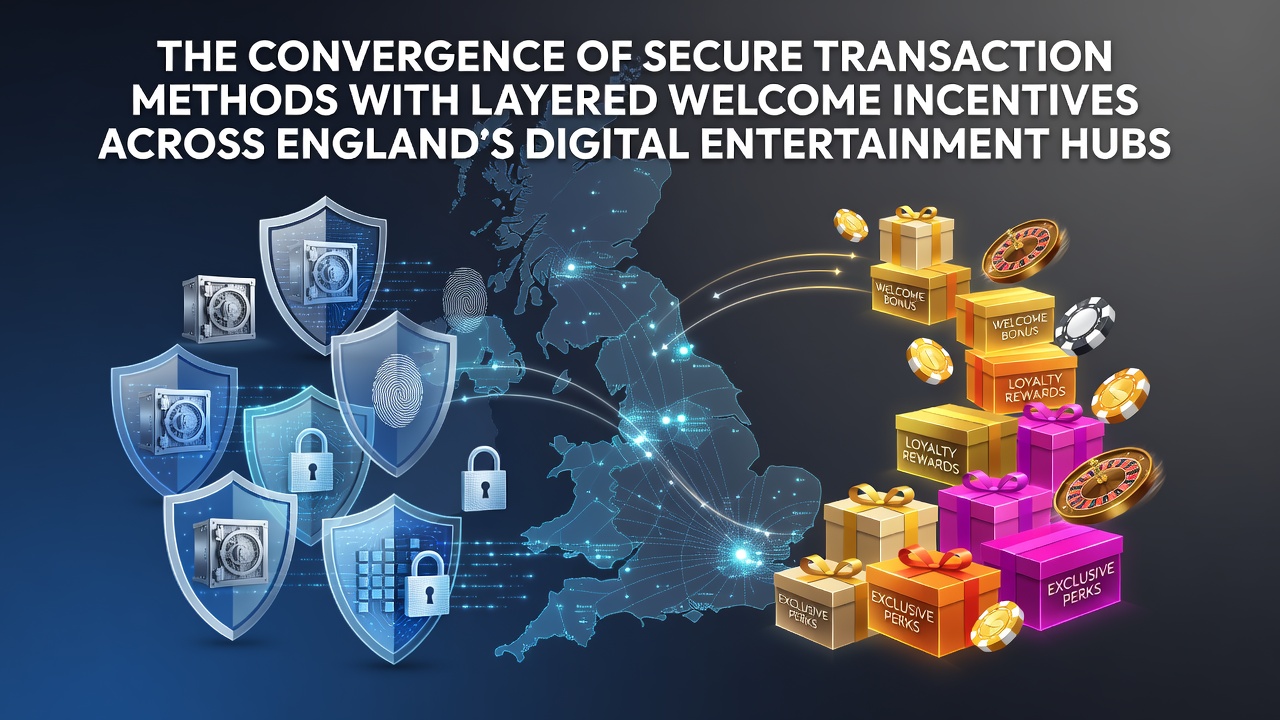
England's Digital Hubs See Secure Transactions Merge with Stacked Incentive Structures
England's online entertainment platforms continue to integrate advanced payment security protocols directly into the structure of welcome incentive packages, creating unified systems where transaction protection and reward layering operate as interconnected components rather than separate features. This development has accelerated through 2026, with operators aligning encryption standards, multi-factor authentication, and real-time verification tools alongside deposit-matched bonuses, free spin allocations, and tiered cashback arrangements that unlock progressively based on user activity levels.
Payment Infrastructure Evolves Alongside Incentive Designs
Digital entertainment hubs across England have adopted payment frameworks that embed security measures at the point of entry for new users, ensuring that initial deposits trigger both verified fund transfers and immediate access to layered rewards. Systems now route transactions through encrypted channels that simultaneously log eligibility for welcome packages, reducing processing delays while maintaining compliance with regional data protection requirements. Observers note that platforms employing these combined approaches report higher completion rates for first-time deposits, as users encounter fewer interruptions between funding an account and activating promotional tiers.
Layered welcome incentives typically begin with a base deposit match that activates upon secure verification, followed by additional free spin credits distributed across subsequent days or activity thresholds. These structures often incorporate cashback percentages that scale with cumulative play volume, all while the underlying payment method remains shielded through tokenization and device-specific authentication. Research from the European Gaming and Betting Association shows that platforms combining these elements experience measurable increases in sustained user engagement during the initial thirty-day period after registration.
Regional Trends and Technical Alignments in August 2026
By August 2026, several English platforms had rolled out unified dashboards where users select a payment option and immediately view the corresponding welcome incentive ladder attached to that method. E-wallet integrations, bank transfers processed through open banking, and card-based systems each carry distinct security certifications that map onto specific bonus multipliers or release schedules. This mapping allows operators to adjust incentive depth according to the risk profile of the chosen transaction channel without requiring separate user actions.
Industry reports indicate that secure transaction volumes in England's digital entertainment sector rose steadily during the first half of 2026, coinciding with the introduction of incentive structures that reward verified, low-risk payment behaviors. One platform implemented a system where users completing transactions through fully authenticated channels received an additional loyalty tier unlock, effectively linking payment security directly to the pace at which welcome rewards become available.

Case Examples from Operational Platforms
Take one operator that introduced a three-stage welcome sequence tied to payment verification stages: an initial deposit match released after basic security checks, a second tranche of free spins unlocked once the transaction clears a secondary fraud screening, and a final cashback layer activated following thirty days of activity recorded through the same protected channel. This sequence demonstrates how transaction security checkpoints serve as natural milestones within incentive progression rather than external hurdles.
Another platform restructured its entry offers around payment method categories, assigning higher reward multipliers to channels with built-in real-time monitoring and lower multipliers to those requiring additional manual verification steps. Data collected across multiple sites shows that users gravitate toward the more secure options when those choices also accelerate access to the full incentive stack, creating a self-reinforcing pattern where protection features and reward depth advance together.
Broader Industry Context and Supporting Data
Figures from the Australian Gambling Research Centre reveal parallel developments in other regulated markets, where secure payment convergence with promotional layering has produced similar shifts in user onboarding patterns. English platforms appear to be adapting these models to local requirements, incorporating region-specific authentication layers while preserving the core principle that transaction security and incentive access function as a single operational flow. Trade analyses from the European Gaming and Betting Association further highlight that operators investing in this integration report reduced instances of payment-related disputes during the critical early user lifecycle.
Technical standards continue to evolve, with many hubs now requiring that payment providers supply API-level confirmation of security status before any portion of a welcome package activates. This requirement ensures that users cannot bypass verification stages to reach deeper reward tiers, maintaining system integrity across the entire incentive structure.
Conclusion
The alignment of secure transaction methods with layered welcome incentives has become a defining operational characteristic of England's digital entertainment hubs. Platforms continue to refine these integrations by mapping payment security milestones directly onto reward release schedules, resulting in streamlined user journeys that satisfy both protection standards and engagement objectives. As technical capabilities advance, the convergence appears set to deepen, with future updates likely to introduce even tighter linkages between verified transaction flows and the progressive unlocking of promotional layers.